As a personal trainer, I hear it all the time: “I want to build muscle and get stronger, but I don’t want to get bulky”. Let’s talk about what people mean when they say this, and what I would say in response.
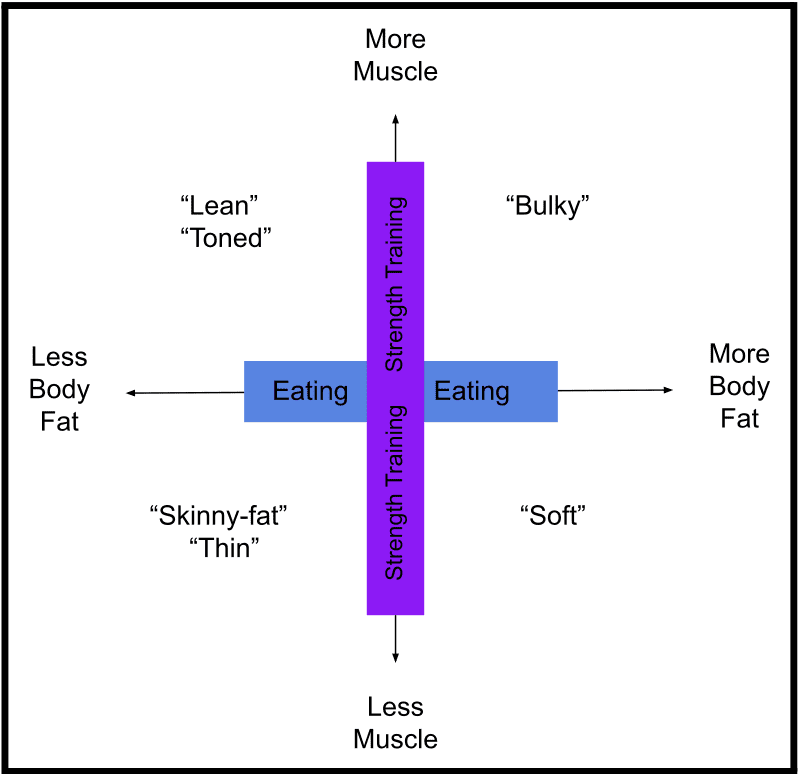
We can think of body composition in terms of two areas: muscle mass, and body fat. Where you land on those continuums will dictate how your body appears (while still taking into consideration genetics and body proportions that are not alterable). Below is a chart to illustrate what I mean:
Let’s turn to bodybuilding lingo to help us understand these concepts. In bodybuilding, the term “bulk” is used to describe a training phase where the athlete is consuming a surplus of calories, and attempting to build strength and muscle mass. Just like contractors need materials to build a house, your body needs calories and fuel to build muscle. Sometimes, in the attempt to build muscle, we may overshoot our calories a bit just to ensure our body has plenty of materials to do the building we’re contracting it to do. This may result in gaining a bit of body fat in addition to gaining muscle. In the bodybuilding world, that’s okay, because it means we’re giving our body more than enough fuel to maximize muscle gain. We also know that when we “cut,” that body fat will come off.
The term “cut” refers to consuming a deficit of calories and attempting to lose body fat while retaining as much muscle mass as possible. Here the athlete will continue to strength train to signal to the body to keep the muscle it has built, yet simultaneously reduce calorie intake so that the body starts using the excess fuel stores (i.e. body fat) to supplement the deficit in calories consumed.
Okay, great. Now what does that mean? By referencing the diagram above, you can see that for the most part, body fat is dictated by eating, and muscle mass is dictated by strength training. There are certainly exercises you can do to reduce body fat (HIIT, Zone 2 training, etc.) and foods you can eat to promote muscle gain (surplus of protein, creatine supplement, etc.), but for simplicity’s sake, we’ll stick with the idea that body fat comes from food intake and muscle mass comes from strength training.
As you can see on the diagram, we have two extremes in terms of body fat with low muscle: very low muscle and lower body fat results in what people call “skinny fat”, or a person who is thin but not toned. This body is achieved by managing caloric intake but not engaging in any progressive strength training. On the other end of the spectrum, we have very low muscle and high body fat, which is generally regarded as “soft” or visibly overweight. This body is achieved by eating a surplus of calories as well as not engaging in any strength training.
On the other end of the muscle spectrum, we have “toned” or “lean,” which references bodies that have low body fat and high muscle. This is generally what people aim for. Achieving this body is done by managing calories (deficit or maintenance, once you are at desired body fat percentage) and engaging in regular, progressive strength training. And finally, there is the “bulky” body, which many fear, and is achieved through progressive strength training and a surplus of calories.
So, in the end, strength training won’t make you inherently bulky. A “bulky” look comes from gaining muscle and body fat. It is actually fairly difficult to put on so much muscle and maintain a low body fat to the point where you look “bulky”. So my message to you is this: strength train and eat enough protein from whole foods in a calorie deficit! You may find after all that you like the outcome.