When discussing health and physical fitness, conversations often gravitate toward muscular strength, cardiovascular endurance, flexibility, and body composition. An often overlooked aspect of overall fitness is balance. Balance can be defined as the ability to maintain the body’s center of mass over its base of support. This involves complex coordination between the eyes, ears, muscles, tendons, joints, and brain.
There are three main sensory systems the body depends on to negotiate balance:
- The visual system, which provides information on where your body is in relation to your surroundings.
- The vestibular apparatus, which are fluid-filled canals within the inner ear that provide information about the head’s position in space.
- Proprioception, which involves special sensory receptors in the muscles, tendons, and joints. Proprioception signals to the brain the precise movement and position of your trunk and limbs.
The central nervous system uses information from all three systems to make instant adaptations to your movements. This allows you to do things like stand up or walk without having to consciously think about it.
There are two types of balance, static and dynamic. An example of static balance is simply standing in one place. Dynamic balance is maintaining control of the body while moving. This could be walking, running, or riding a bike. No matter your phase of life or fitness goals, there are advantages to balance training, including:
- Enhancing everyday functioning – balance training improves joint stability which helps with daily movements such as walking upstairs, carrying children, picking up items off the floor, and reaching for items on shelves.
- Fall prevention – poor balance increases the risk of falls, which are a leading cause of injuries, including fractures, which can lead to a loss of independence.
- Core strength – practicing balance naturally activates the core which strengthens the abs, obliques, lower back, pelvic floor, and glutes.
- Improved athletic performance – sports require dynamic balance and strong balance increases agility, coordination, and overall performance.
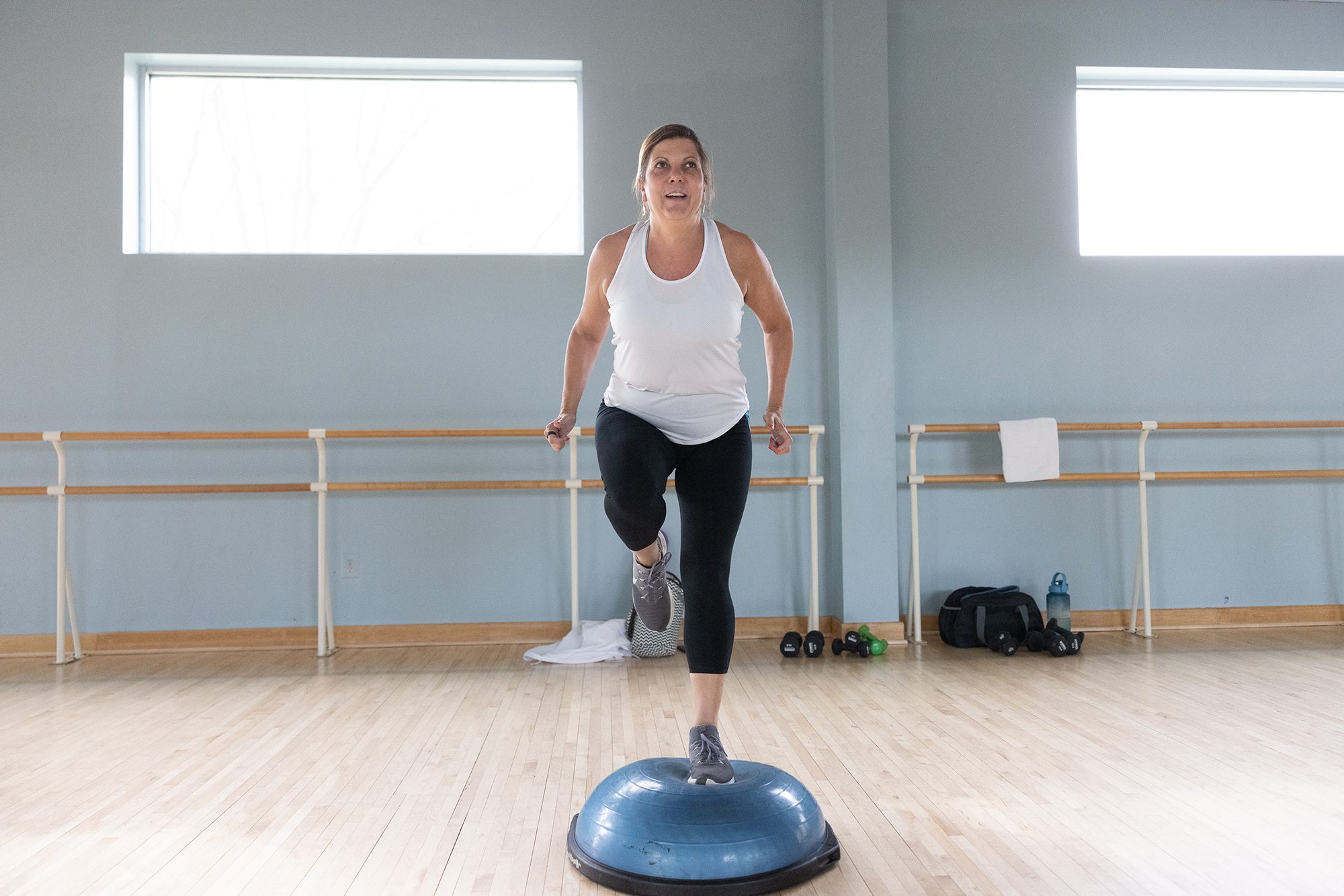
So, how can you start to work on your balance? A great place to start is by strengthening your leg muscles. Squats, calf raises, and glute bridges are all effective exercises that could begin with two feet on the ground. The first progression would be to put the majority of the weight into one leg while the other foot is nearby to help negotiate the balance. The second progression would be putting all of the weight into one leg. An additional progression would be adding an unstable surface, such as wobble board. Adding an unstable surface requires more signals between the sensory receptors of the muscles, tendons, joints and the brain to make the quick adjustments to maintain balance.
Another way to improve balance is to strengthen the core. Planks and hovers are effective exercises that require bracing the core. The first progression would be increasing the time holding the position. A second progression could be using an unstable surface, such as a BOSU, to challenge the core even more.
A third way to train balance is to reduce visual sensory feedback. This can be done by practicing balance drills with eyes closed or in a dimly lit room. Reducing visual feedback increases greater dependence on proprioception and the vestibular apparatus and can help increase the coordination of these systems. When practicing balance with reduced visual feedback, make sure you are in a safe space where you won’t fall and injure yourself.
It doesn’t matter if you are a high performing athlete, new to fitness, or have made many trips around the sun. Adding balance exercises into your routine will help improve your everyday movements and quality of life. Why not get started today? If you need help, ask one of our trainers. We are here to help!